
Breathing & Anesthesia Circuits: The Critical Link Between Equipment and Patient #
Hsiner’s largest product category covers the components that connect anesthesia machines and ventilators to the patient: anesthesia masks, breathing circuits, connectors, filters, tubing and catheter mounts. The range includes disposable and reusable options, single-limb and dual-limb circuits, and specialized configurations for PLV, IPPB, EMS and APL ventilation.
Official category page: Breathing & Anesthesia Circuits
Anesthesia Masks #
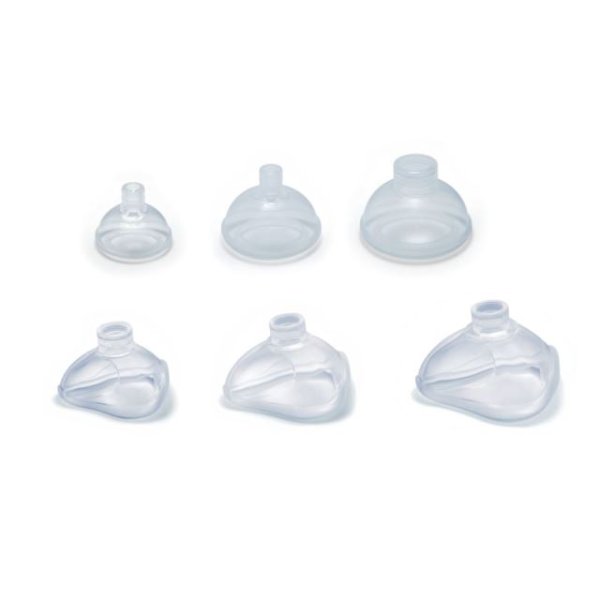
- Anesthesia mask, silicone — Contoured silicone mask for the oral-nasal area with a stable airtight seal. Transparent body for airway observation and an inflatable cuff that adapts to different facial profiles; pediatric to adult sizes.
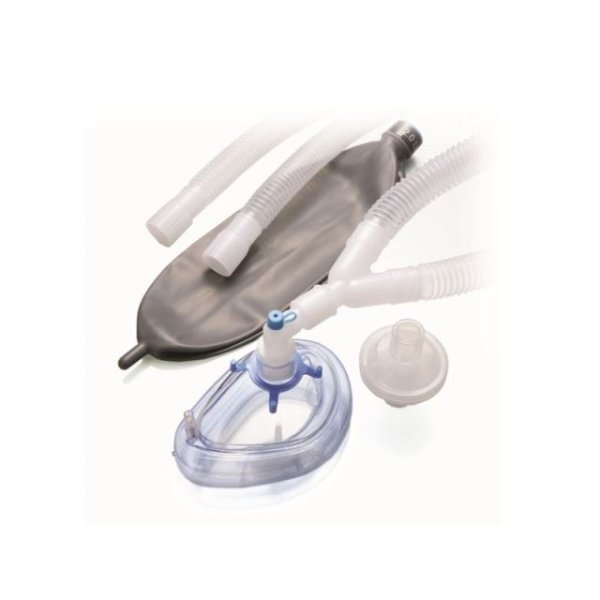
- Air cushion anesthesia mask (without valve) — Transparent PVC cushion that conforms to facial contours, with a clear body for airway monitoring. Seven sizes from neonatal to adult.
- Air cushion anesthesia mask (with rear valve) — Inflation valve at the rear of the mask allows cushion pressure adjustment without repositioning the mask, reducing prolonged skin compression.
- Air cushion anesthesia mask (with top valve) — Inflation valve on top of the mask allows front-side adjustment without rotating the mask, maintaining a consistent seal across facial anatomy.
- Air cushion anesthesia mask (MRI-compatible) — Fully metal-free construction using silicone and non-metallic components for safe use in MRI environments. Adjustable cushion inflation and a clear mask body.
- Air cushion anesthesia mask (stepped frame) — Stepped frame increases the contact area for single- or two-handed holding, improving stability during prolonged anesthesia procedures.
Breathing and Anesthesia Circuits #
- Reusable anesthesia / breathing circuit — Liquid silicone circuit with PSF supporting components. Soft, kink-resistant tubing withstands repeated autoclaving; optional PSF water trap.
- Collapsible breathing circuit — Extendable circuit that can be lengthened or compressed, saving storage space and reducing bedside clutter while maintaining stable gas flow.
- Breathing circuit with water trap — Circuit with an integrated, detachable water trap that collects condensation along the tubing for easier drainage during surgery.
- Anesthesia circuit with parallel connector — Parallel-limb circuit with inspiratory and expiratory tubing routed side by side, reducing tubing interference around the surgical field.
- Anesthesia circuit with Y connector — Standard Y-piece circuit separating inspiratory and expiratory limbs. Corrugated tubing allows flexible routing; ISO 5356-compliant connectors fit major anesthesia workstations.
- Coaxial circuit — Inspiratory limb runs inside the expiratory limb, presenting as a single tube. Reduces bedside footprint; heat exchange between gas flows helps maintain inspired gas temperature.
- PLV breathing circuit (single limb) — Single-limb pressure-limiting ventilation circuit with an integrated two-port pressure control valve that monitors circuit pressure and relieves excess pressure.
- PLV breathing circuit (dual limb) — Dual-limb PLV circuit with separate inspiratory and expiratory tubing and a two-port pressure control valve for continuous pressure monitoring.
- Hyperinflation breathing system — Pressure relief valve assembly for fast manual control of circuit pressure, allowing quick pressure build-up and release during clinical checks or manual ventilation.
- EMS breathing system — Lightweight, fast-assembly circuit for emergency and pre-hospital use, compatible with manual resuscitators and emergency oxygen equipment.
- IPPB breathing circuit — Dedicated circuit for intermittent positive pressure breathing therapy, supporting lung expansion and aerosol medication delivery.
- APL coaxial circuit — Combines an adjustable pressure limiting (APL) valve with a coaxial circuit, retaining the space-saving single-tube layout while adding manually adjustable exhaust pressure control.
- APL hyperinflation system — Standard APL circuit set with an adjustable pressure limiting valve, breathing bag and corrugated tubing; supports switching between manual ventilation and spontaneous breathing.
Filtration and Humidification #
- Bacterial filter — Filters bacteria and particulates to protect the patient airway and downstream equipment from contamination.
Connectors, Valves and Sampling Accessories #
- Manifold connector — Circuit control valve with a pressure line port for airflow regulation.
- CO2 sampling line — Connects to mainstream or sidestream monitors for exhaled CO₂ sampling.
- Water trap — Captures condensation within the circuit; the collection chamber is detachable.
- Pressure line adapter — Dedicated adapter connecting the breathing circuit to pressure monitoring lines.
- L connector — Angled adapter for routing at the patient end; some models include a swivel or sampling port for pressure or EtCO₂ monitoring.
- Wye connector — Multi-port connector for circuit branching and device expansion.
- MDI adapter — Interfaces with metered-dose inhalers to deliver medication into the circuit.
- Straight connector — Straight-through adapter for connecting different circuit port sizes.
- T connector — T-shaped connector for branching or inline device integration.
- APL valve — Adjustable pressure-limiting valve integrated into the breathing circuit.
- Safety cap — Seals unused circuit ports to prevent gas leakage and contamination.
- Nose clip — Lightweight clip for breathing circuits or pulmonary function testing.
- Mouthpiece — Oral interface for breathing circuits or diagnostic equipment.
Tubing and Catheter Mounts #
- Disposable catheter mount — Flexible catheter mount bridging the endotracheal tube and breathing circuit.
- Reusable catheter mount — Short silicone tube segment for close-range connection between circuit components.
- Collapsible tubing — Expandable corrugated tubing with adjustable length for flexible circuit configuration.
- Silicone tubing — Reusable, autoclavable silicone tubing for long-term clinical use.
- Corrugated tubing (EVA) — EVA corrugated tubing with flexible bending and stable gas delivery.
- Smoothbore tubing (PVC) — Smooth inner wall reduces airflow resistance and condensation retention.
Circuit Accessories #
- Test lung — Simulates lung compliance and resistance for equipment calibration and circuit testing.
- Reservoir bag — Manual ventilation reservoir for anesthesia machines or resuscitators.
- Hose clip — Secures tubing to equipment rails for organized circuit routing.
- Water collection bag — Collects circuit condensation to maintain unobstructed gas delivery.
- Strap / headgear — Adjustable headgear strap for securing anesthesia masks during procedures.
Related Clinical Solution #
- Breathing & Anesthesia Circuit Solutions — How masks, circuits, connectors and humidification-filtration products work together in the OR, ICU and home care.